
Knifeless Trimming: Why the Best Installers Skip the Blade
Why blades are risky
Trimming vinyl directly over paint with a razor creates microscopic score lines across the OEM clear coat. Those scores compromise paint integrity and lead to premature clear coat peeling and rust beneath the wrap. Master installers eliminate utility blades over painted panels entirely.
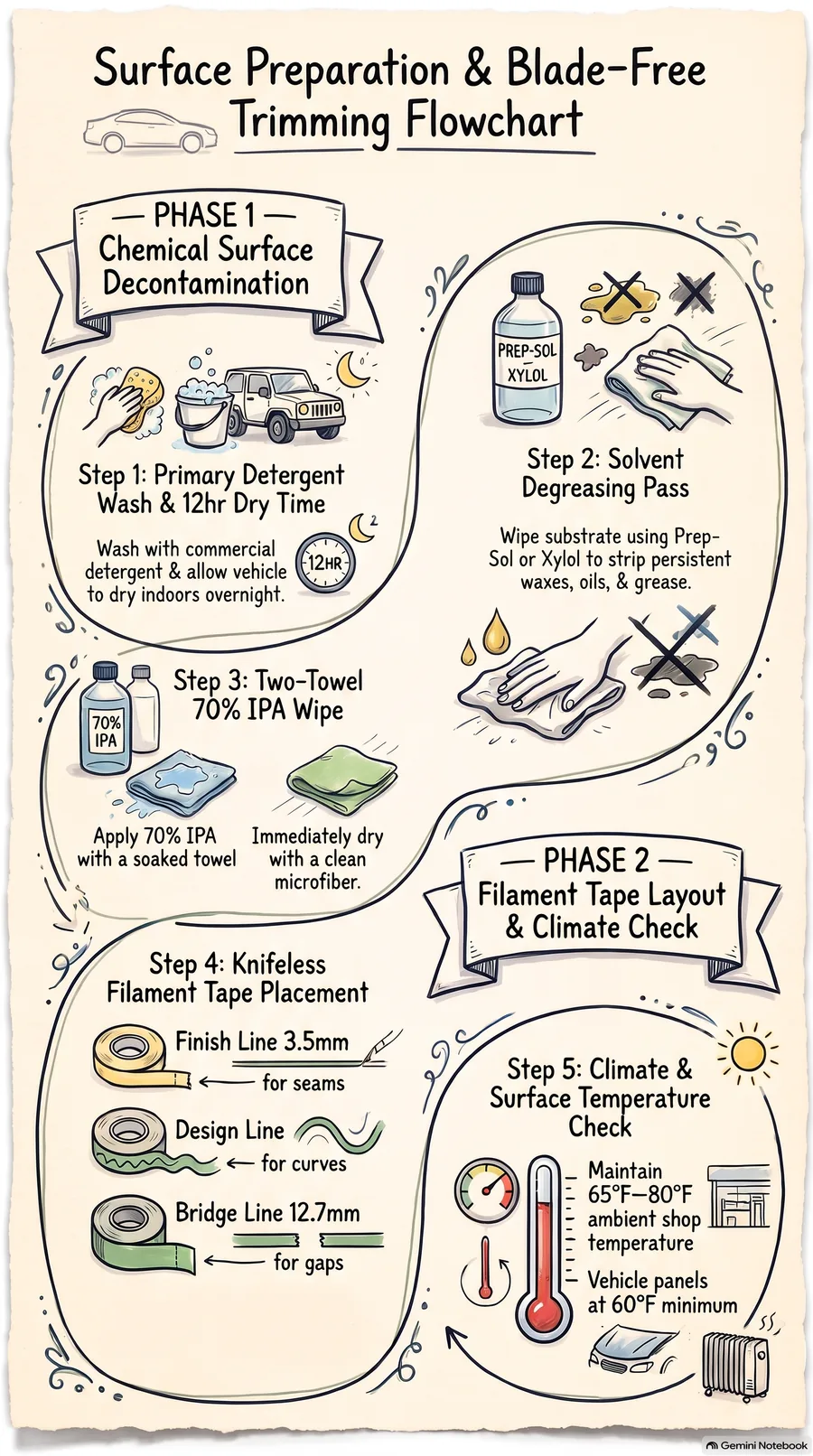
The three-step decontamination sequence
Flawless adhesion starts with a strict three-step prep. First, a detergent wash and thorough dry. Second, a solvent pass with Prep-Sol or Xylol to strip waxes and silicones. Third, a two-towel 70% isopropyl alcohol wipe — a wet towel to dissolve residual oils, then a clean microfiber to dry before the solvent evaporates.
Knifeless filament tape
Filament tape puts a high-tensile cutting line inside a pressure-sensitive carrier. Finish Line tape (3.5 mm) follows tight curves and panel returns, Design Line tape handles ultra-tight artistic radii, and Bridge Line tape (12.7 mm) spans door and fender gaps for clean parallel cuts across voids in a single pull.
Executing a clean cut
After laying vinyl over the tape, the installer pulls the filament upward through the film to shear it from beneath with zero blade contact. Every cut edge is then re-squeegeed with firm pressure to seal the panel returns. This is the standard behind precise vinyl graphics and lettering.
Ready to wrap?
Get a free, no-obligation quote for your vehicle — color change, fleet graphics or paint protection.
Call or text (239) 522-0096