
How Self-Healing Paint Protection Film Actually Works
Aromatic vs. aliphatic TPU
Early paint protection films yellowed within 12–24 months because their aromatic diisocyanate chemistry photo-oxidized under UV. Modern high-tier PPF uses 100% aliphatic TPU, which resists solar oxidation, transmits up to 99.8% of visible light, and carries a 10-year non-yellowing lifespan.
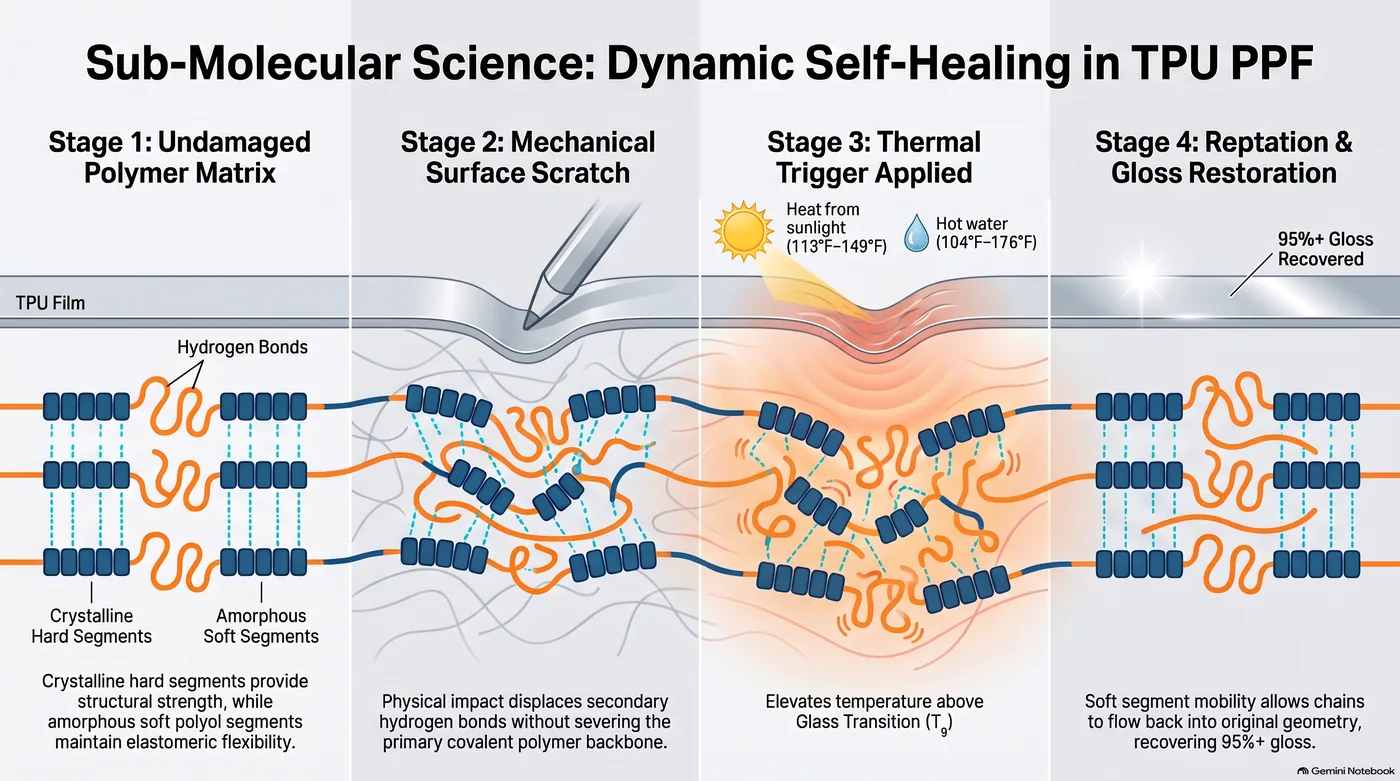
A linear block copolymer
TPU balances toughness with flexibility through a segmented structure. Hard crystalline segments act as physical crosslinks that deliver 15–19 MPa of tensile strength, while soft amorphous polyol segments allow 150%–400% elongation without failure.
How a scratch forms
When road grit scratches the topcoat, mechanical force displaces polymer chains. The impact primarily stretches secondary hydrogen bonds between chains rather than severing the primary covalent backbone — which is exactly why the damage is recoverable.
Heat triggers the fix
Because TPU has a glass transition temperature between -40°C and -10°C, applying heat above 40°C–80°C — from direct sunlight or warm water — gives the soft segments rapid mobility. The chains then flow back into their baseline geometry through reptation, recovering 70%–95%+ of original gloss. That is why paint protection film in Tampa keeps healing under the Florida sun.
Ready to wrap?
Get a free, no-obligation quote for your vehicle — color change, fleet graphics or paint protection.
Call or text (239) 522-0096