How to Choose the Right Wrap Film: A Material Selection Guide
Why film choice decides the outcome
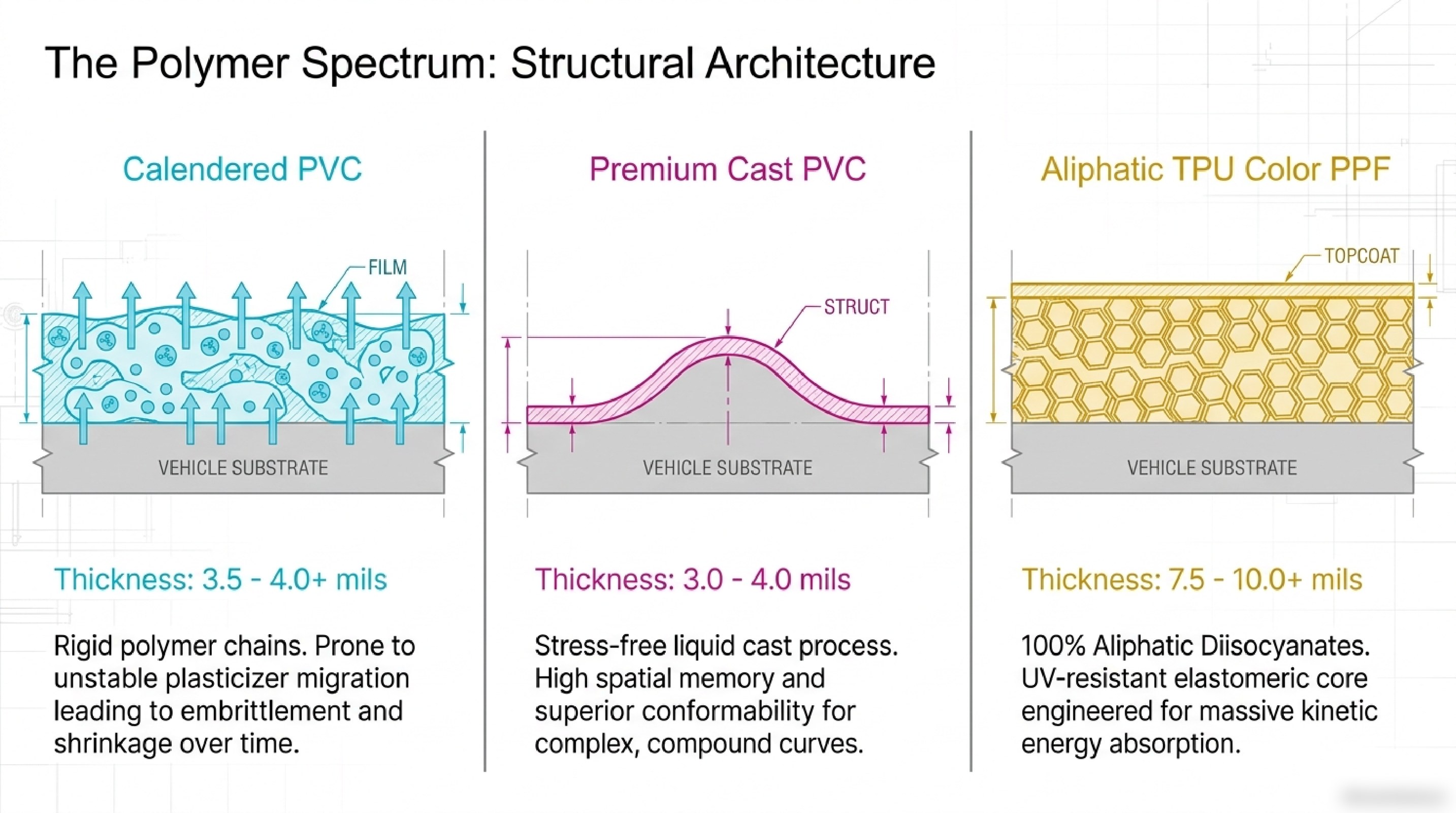
Every wrap film starts from a different polymer architecture, and that architecture sets how the film behaves for its whole service life. Calendered PVC is extruded through heavy heated rollers, which leaves the sheet full of intrinsic memory — it constantly tries to shrink back to its rolled state. Premium cast PVC is poured as a liquid and baked stress-free, so it holds almost no built-in tension and conforms over compound curves. Aliphatic TPU color PPF is engineered from 100% aliphatic diisocyanates with a UV-resistant elastomeric core, built to absorb kinetic energy instead of just covering paint.
That single difference in manufacturing explains most wrap failures and most wrap successes. Choosing the wrong film for the mission is the fastest route to warranty claims.
The selection matrix: five attributes that matter
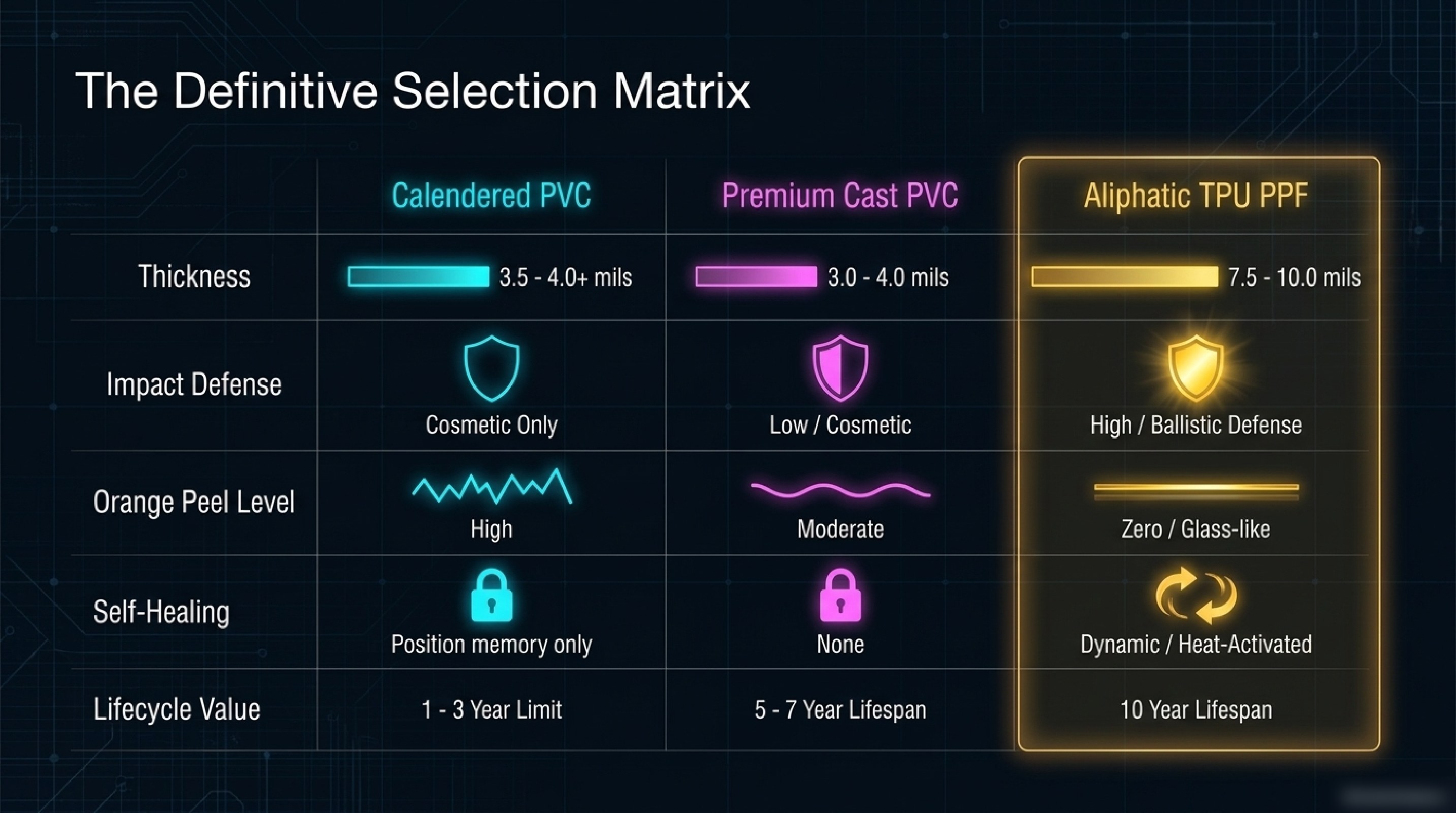
Put the three film families side by side and the trade-offs become clear. Thickness runs 3.0–4.0 mils for calendered PVC, 3.5–4.0+ mils for cast PVC, and 7.5–10.0+ mils for TPU PPF. Impact defense ranges from cosmetic-only on calendered to high, ballistic-grade chip defense on TPU. Orange peel — the surface texture left by manufacturing — is highest on calendered, moderate on cast, and zero (glass-like) on TPU.
Self-healing tells the same story: calendered PVC has none, cast PVC relies on position memory only, and TPU self-heals dynamically when heated. Lifecycle value lands at a 10-year lifespan for TPU, 5–7 years for cast PVC, and a 1–3 year limit for calendered. Our cast vs. calendered guide breaks down the two PVC options in depth.
How TPU defends and heals itself
Aliphatic TPU earns its price through mechanics. Its cross-linked elastomeric soft segments absorb and disperse kinetic energy laterally when gravel or road debris strikes, while the primary covalent bonds stay intact — which is why it shrugs off rock chips instead of chipping paint. When a scratch does form, thermal energy between 40°C and 80°C — sunlight or warm water — grants the soft segments enough mobility to flow back into their original spatial memory, erasing the mark. Read the full self-healing chemistry.
Matching film to mission: lifecycle ROI
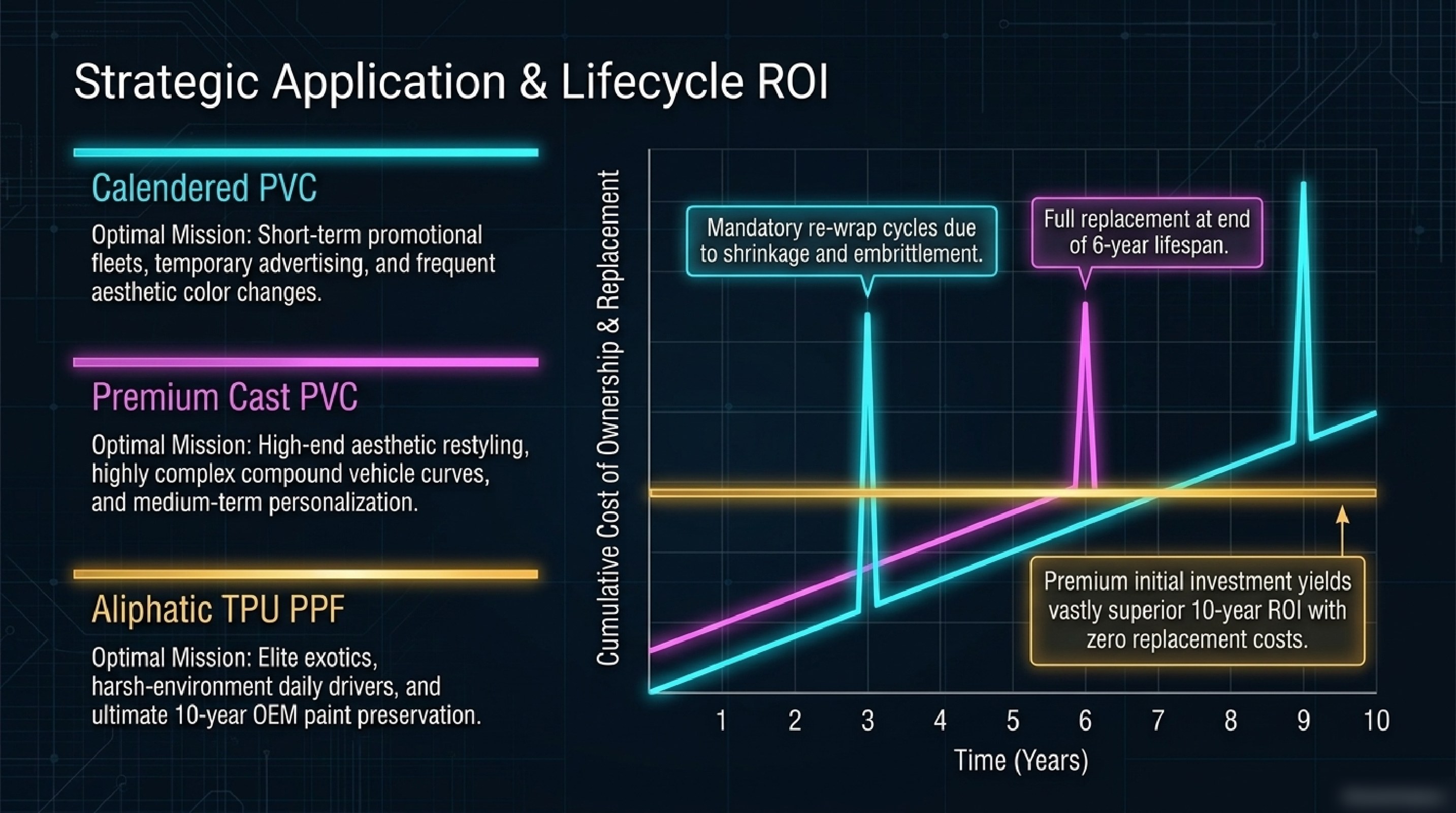
Each film has an optimal mission. Calendered PVC suits short-term promotional fleets, temporary advertising and frequent aesthetic color changes — its 1–3 year life and low upfront cost fit a campaign that will be re-wrapped anyway. Cast PVC is the workhorse for high-end aesthetic restyling, complex compound curves and medium-term personalization, delivering a 5–7 year life.
Aliphatic TPU PPF sits at the top of the stack for elite exotics, harsh-environment daily drivers and owners who want 10 years of OEM paint preservation. Over a decade the premium upfront investment yields a far lower total cost of ownership because there are zero mandatory replacement cycles — calendered PVC forces full re-wraps as it shrinks and embrittles.
Ready to wrap?
Get a free, no-obligation quote for your vehicle — color change, fleet graphics or paint protection.